The inclusion strategy: what governors and trustees need to know
In this guest blog, inclusion adviser and experienced governor Aaron King explores what the new inclusion strategy means for governors and trustees. Learn what boards need to know about their role, available funding, and how to scrutinise plans effectively.

A new system of school improvement is hitting the inboxes of governors and trustees this term: the inclusion strategy.
Its unfortunate name doesn’t immediately tell you what it is. After all, the term ‘inclusion strategy’ could mean anything from improving ramp access at all entrances to enhancing diversity in your workforce.
In simple terms, it means ‘An action plan for inclusion – especially special educational needs and disabilities (SEND).’ It is for mainstream schools only.
Why do schools need an inclusion strategy?
The government’s Schools White Paper says too many children with SEND have been told they cannot thrive in mainstream schools. There are many stories of success, but, overall, the SEND system is not closing the gap.1
The government want to transform this and have committed £1.6 billion to a grant called the Inclusive Mainstream Fund (IMF). Of this, £1.2 billion is promised for schools over a three-year period, with the rest of the fund supporting inclusion in early years, sixth forms and colleges.
Is it compulsory for every school to have an inclusion strategy?
Yes. The government have used the Education Act 2002 to add conditions to the Inclusive Mainstream Fund grants. If you accept your grant (and why wouldn’t you?), then you accept the condition to publish an inclusion strategy.
What is the role of governors and trustees in the inclusion strategy?
The Department for Education (DfE) say that the development of your inclusion strategy is a shared responsibility across the school leadership team, and this can include governors and trustees.2 The DfE expect that it will be refined through scrutiny by governors and trustees.3
Do governors/trustees need to approve the strategy?
No. You are not required to approve the strategy – but the DfE do expect you to scrutinise it.
The first strategy must be published by 31 December 2026. Because many boards don’t meet in December, your scrutiny might happen after publication. That’s OK as the DfE do not give a deadline for governor scrutiny.
Will Ofsted check the inclusion strategy?
Ofsted say that they will look at the inclusion strategy as part of inspection.
Their toolkit says that inspectors will evaluate how well leaders, alongside governors/trustees, have developed an inclusion strategy that sets out how your overall funding will:
- meet the specific needs of your cohort, and
- improve inclusive practice across the school.4
A key point is that the inclusion strategy should explain how a school is spending the grant but also how it spends its overall notional SEND funding (this is an estimate of how much of the school budget is needed to support SEND).
How much IMF funding will your school get?
Each school receives a £3,000 lump sum. Then, a school’s IMF grant depends on pupil numbers, prior attainment, and area costs (e.g. schools in higher cost areas like London get an uplift).
The grant is around £13,000 for an average primary school and £48,000 for an average secondary school.5 You can find your school’s allocation in the DfE’s published lists.6
Some schools might feel that their grant isn’t much. But focus on what you can do with the grant you have rather than the grant you wish you had.
Scrutinising what schools can spend IMF grants on
Boards should know what money can (or can’t) be spent on so that they can effectively scrutinise the school’s plans.
In short, IMF grants can be spent on any new activity that is evidence-based and improves inclusion, but not on bricks and mortar.
School wants to open an inclusion base? Great. The new walls and doors must be paid for by other money. Then, once the paint has dried, anything within those new rooms can be funded by IMF.
Or does a school want to release staff to visit specialist provision, buy in extra speech and language therapy or improve transition for new pupils? If so, these are great ways to spend the money.
The three key strands that should inform your school leaders’ decision-making are: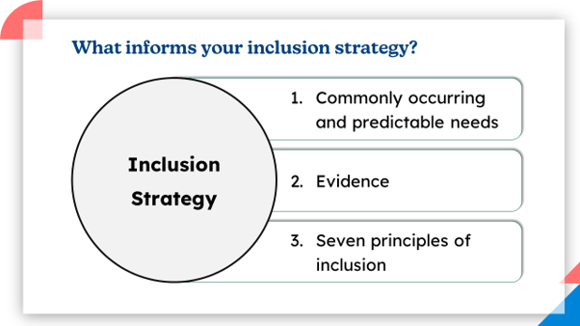
1. What are the school’s commonly occurring and predictable needs?
What this means is different for each school. For some primary schools, it includes pupils arriving in reception who have poor speech and language. For some secondary schools, it includes autism or emotionally-based school avoidance.
Other common and predictable needs are social and emotional, mental health, learning difficulties or ADHD.
2. Is the inclusion strategy based on evidence?
This includes published research about effective inclusion. The DfE have published eight research guides on common needs. Furthermore, the Education Endowment Foundation has excellent work on effective inclusion (for example their ‘Five-a-day’ or Teaching and Learning Toolkit).
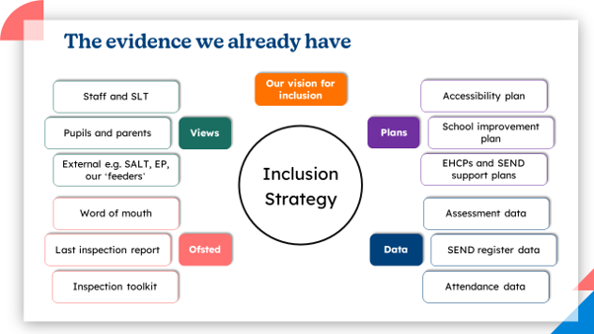
Equally important is the evidence that the school already has. This is not simply assessment data – governors will want to see that a wide range of in-house evidence is used:
3. Is the spending in line with the DfE’s seven principles of inclusion?
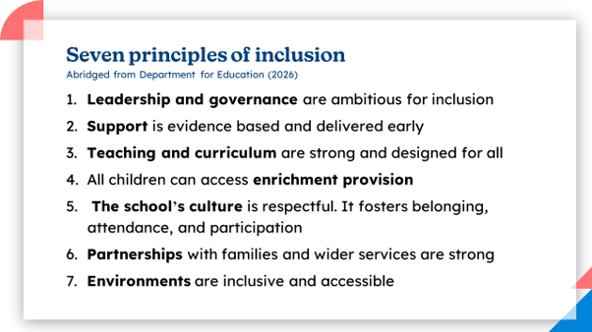
If governors can see that the school’s spending is aligned with at least one of the seven principles, then this strand is unlikely to delay the publication of your inclusion strategy.
Two things that the IMF grant cannot be spent on
- Existing activities. It must be spent on ‘new’ activities.
- Capital improvements (e.g. building two new intervention rooms).
What a good inclusion strategy looks like
When you read the strategy, look for these four things:
Universal as well as SEND support: A good inclusion strategy improves the inclusivity of all teaching. This helps the funding to reach the most diverse range of pupils possible. An example of this is implementing the ‘Five-a-day’ (EEF guidance on inclusive teaching).
Ambitious for tangible change: A good strategy includes ambitious measures for change. These can be academic, for example, how many pupils can read at the expected standard for their age. But a good strategy also targets wider outcome measures (e.g. belonging, behaviour or attendance). Legitimate goals include ‘No pupil is severely absent’ or ‘95% of pupils (or more) report having a good friend they can trust’.
Crystal clear: A good strategy is not cloaked in jargon. It is so straightforward that a ten-year-old could read it. A sign of a good strategy is that you can tell what will be tangibly different, why and how. If you can’t, that lack of clarity may get in the way of the school delivering its strategy.
Focused: A good strategy focuses on a few activities and does them well.2
What role do trustees of academy trusts have?
Trustees can be responsible for one school (in a single academy trust) or dozens (in a multi-academy trust (MAT)). Few MAT trustees will have time to read and scrutinise the inclusion strategy for all of their schools.
The approach and questions from MAT trustees will be different from those of local governing boards. MAT trustees will need to scrutinise whether the strategies are in place and how trust leaders will ensure that there is local scrutiny and monitoring of the plans.
If funds are pooled in a MAT, trustees should scrutinise the financial governance to ensure that this money is well spent (and that each school publishes its own strategy).
Four practical tips for governors and trustees
1. Get on the front foot for your inclusion strategy
Send a message to the leader responsible for the inclusion strategy. Let them know you’re looking forward to reading it and learning about the changes being planned. This isn’t so much about accountability as about support. It matters that leaders know how much you value this plan.
2. Set a date for monitoring now
Getting busy people together can be tricky. Put your monitoring date in the diary now – 20 weeks from now. This could be a visit to school, followed by 40 minutes with the special educational needs co-ordinator to review success and what’s still to achieve.
3. Save or print the NGA/9000 Lives questions on the inclusion strategy
These questions focus on evidence, leadership and outcomes. There are separate sections for governors and for trustees, and each follows the same three stages of the cycle:
- Scrutinising the strategy
- Monitoring the strategy
- Reviewing the strategy
Inclusion strategies are reviewed annually, so the monitoring and reviewing stages are vital for reflecting on success and the next steps.
You should also share this blog with your board so that they are equally well-informed.
4. Watch one of NGA’s two webinars on the inclusion strategy
- Inclusion strategy webinar: insert link here for on demand
- NGA SEND Network: The inclusion strategy and best practice for boards
Inclusive by design
The work is already underway for every single school to become inclusive by design.
The inclusion strategy is a tool to help speed up the transformation.
This blog and the questions help you to play your part in making every school inclusive by design.

Guest contributor
Aaron King is an inclusion advisor. He works with schools, colleges and education organisations to improve inclusion. He has been a governor for 17 years in both maintained and academy schools.
Related content
-
Research
![]()
-
Guidance
![school-environment pupil raising hand in class]()
-
Tools & templates
![two ladies and a man smiling in a meeting]()
-
Guidance
![people in meeting looking across each other at table]()
-
Guidance
![tools-resources money jar half full]()
-
Guidance
![school-environment pupils running on field]()
-
Guidance
![school-environment young pupils in class reading with the teacher]()
-
Guidance
![Pupils-learning having packed lunch]()
-
Guidance
![school-environment large empty colourful classroom]()
-
Guidance
![school-environment school building]()
-
Guidance
![Pupils-learning young pupils learning in front of the teacher]()
-
Guidance
![school-environment line of pupils walking together]()
-
Guidance
![school-environment young pupils playing rock paper scissors]()
-
Guidance
![someone holding a molded clay heart]()
-
Guidance
![tools-resources someone checking over a document holding their pen]()


-
Blog
![]()
-
News
![]()
-
Blog
![]()
-
Blog
![]()
-
News
![]() Updated: 14/09/2026Compliance & legislation
NGA responds to new school food standards and governance expectations
-
Blog
![]() Updated: 11/09/2026Safeguarding
Dismissed, deserted and disregarded: my experience of allergies in school
-
Blog
![]()
-
News
![]()
-
News
![]() Updated: 13/08/2026Monitoring & outcomes
Results day 2026: A-Level, T-Level and vocational Level 3 results
-
Blog
![]() Updated: 15/07/2026Finance & resources
Tighter Restrictions on Executive Pay – a necessary first step
-
Blog
![]() Updated: 07/07/2026Finance & resources
Making every pound count: what governors and trustees need to know about the new Maximising Value for Pupils programme
-
News
![]()
-
News
![]()
-
Blog
![]() Updated: 18/06/2026Clerking
Raising the Voice of Governance Professionals: Why the Role Matters More Than Ever
-
News
![]()


-
Events & networks
![]()
-
Events & networks
![]()
-
Events & networks
![]()
-
Events & networks
![Pupils-learning painting coloured circles]()
-
Events & networks
![]()
-
Events & networks
![]() 22/09/202618:00 - 19:30ZoomStakeholder engagement
Local Associations Network Meeting - Autumn 2026
-
Events & networks
![]()
-
Events & networks
![]()
-
Events & networks
![]() 10/07/20269:45 - 16:30The Vox Conference Venue, B40 1PULatest updates
National Governance Conference for Schools and Trusts 2026
-
Events & networks
![]() 19/11/202610:00 - 15:30NEC, Marston Green, Birmingham, B40 1NTLatest updates
Annual Conference and AGM 2026
-
Events & networks
![]()
-
Events & networks
![]()


-
Training & development
![People discussing paperwork at a meeting]() 12/05/20273:30-5:30pmZoomGoverning board roles
Understanding the role of Trust Members - May 2027
-
Training & development
![]() 27/01/20276:00-8:00pmZoomCompliance & legislation
Health & Safety: The Governance Role - January 2027
-
Individual training
![training working in groups of two]() 10/11/202618:00-20:00ZoomGoverning board roles
Governance Essentials for SAT Trustees - Autumn 2026
-
Training & development
![training man and woman working from same laptop]() 09/11/20266-8pm This course is now closed.ZoomSchool & trust leaders
Getting headteacher performance management and appraisal right - Nov 2026
-
Training & development
![]() 11/03/20279:30-11:00amZoomClerking
Demystifying the role and responsibilities of the company secretary in academy trusts - March 2027
-
Training & development
![]() 17/06/20279:30-11:00amZoomClerking
From Risk Registers to Real Insight: Risk Management for Governance Professionals - June 2027
-
E-learning
![]()
-
E-learning
![]()
-
E-learning
![]()
-
Consultancy
![two people exchanging documents in a meeting]()
-
Consultancy
![Lady smiling in meeting]()
-
E-learning
![]()
-
E-learning
![]()
-
Consultancy
![training three people taking notes from same laptop]()
-
Training & development
![People discussing paperwork at a meeting]() 03/11/20263:30-5:30pmZoom (This course is now closed)Governing board roles
Understanding the role of Trust Members - Nov 2026


